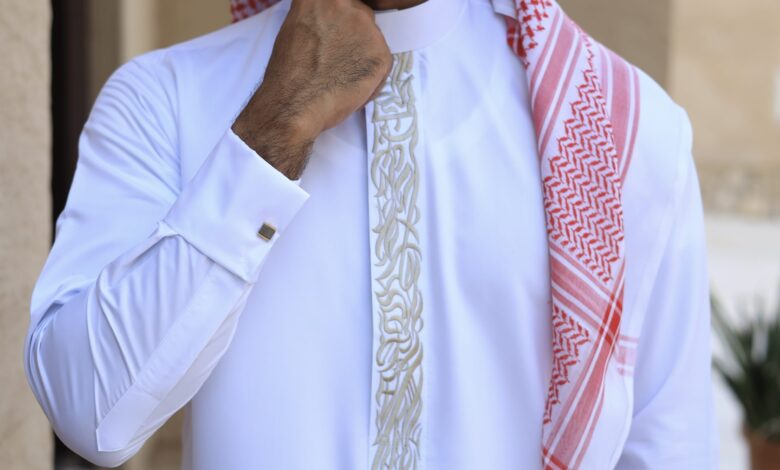
In many parts of the Gulf, the white thobe is more than a practical garment. It carries social meaning. While comfort and religious guidance play a role in its popularity, the colour white has also come to signal respectability, formality and shared identity. Step into a business meeting in Riyadh or Doha and you will often find senior executives dressed in white. Attend a wedding or Eid prayer and the same colour dominates. Over time, white has become the standard against which other colours are measured.
A Colour That Signals Occasion
One reason for the strong preference is its association with important moments. White is widely worn for Friday prayers, religious holidays and family celebrations. Because of this, it has developed a reputation as the “proper” choice for formal settings.
Even in countries where men own thobes in grey, beige or navy, white is often chosen when the occasion matters. It feels appropriate. It feels complete. That expectation reinforces its popularity year after year.
A Shared Public Image
In Gulf societies, national dress remains visible in daily life. The white thobe forms a large part of that public image. It presents a clean, unified appearance in offices, ministries and public gatherings.
This shared look can strengthen a sense of belonging. When large groups of men dress similarly, it reduces visible social differences. Wealth, profession and background become less obvious at first glance. The colour contributes to that uniformity.
Simplicity as a Statement
White carries a quiet confidence. It does not rely on bold tones or decorative detail. Its impact comes from clarity and neatness. In cultures where modesty and composure are valued, this simplicity aligns well with social expectations.
There is also a discipline to wearing white regularly. It requires care. Marks show easily, and regular washing is necessary. Choosing white signals attention to personal presentation. In this way, the garment reflects habits as much as taste.
Climate Still Matters
Although social meaning is important, practical reasons remain relevant. In high temperatures, lighter colours are simply more comfortable. That original practical advantage helped white establish itself long ago.
Once a colour becomes widely adopted, custom strengthens it further. Younger generations grow up seeing fathers and community leaders wearing white. It becomes the reference point for how a thobe should look.
Not the Only Option
It is worth remembering that white is not a religious obligation. Men across the Muslim world wear a range of colours. In North Africa and parts of South Asia, cream and earth tones are common. In cooler months in the Gulf, darker shades appear more frequently.
Yet despite these variations, white remains dominant in many regions. Its connection to faith, climate and public life has given it staying power.
The continued popularity of the white thobe cannot be traced to one reason alone. It sits at the meeting point of tradition, practicality and social expectation. Over time, those factors have reinforced one another. The result is a garment that feels both ordinary and significant at the same time.