Capacity Requirement Planning: Optimizing Production Efficiency with Smart Capacity Management
How CRP Balances Demand and Resources for Business Success

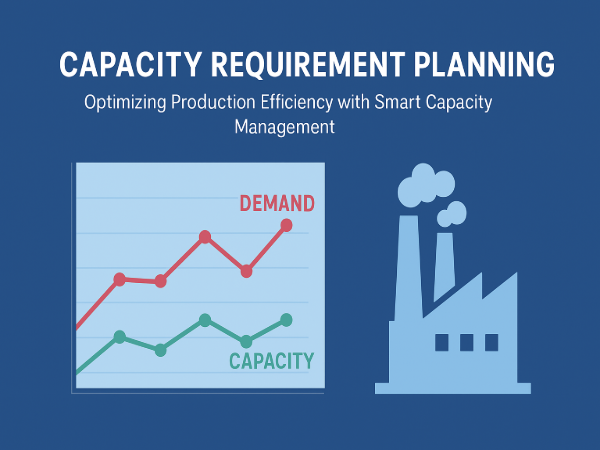
Capacity Requirement Planning (CRP) is a vital process in manufacturing and production management that ensures a company’s available resources—such as labor, machines, and facilities—align with the demand outlined in its production schedule. By comparing planned workloads with actual capacity, CRP identifies potential gaps or surpluses, allowing businesses to adjust proactively and achieve greater efficiency, cost savings, and on-time delivery.
Introduction to Capacity Requirement Planning
In today’s highly competitive business world, manufacturers cannot afford inefficiencies in their production processes. Every hour of labor, every machine cycle, and every unit of facility space must be optimized to deliver products on time while minimizing costs. Capacity Requirement Planning (CRP) is the tool that makes this possible. It connects the dots between demand planning, material availability, and resource capacity, ensuring that organizations can execute production schedules without delays, bottlenecks, or wasted investments.
CRP plays a crucial role in bridging the gap between what a company plans to produce and what it is actually capable of producing. While Material Requirement Planning (MRP) focuses on ensuring that materials are available, CRP ensures that the production resources are capable of turning those materials into finished products within the required time frame.
This article provides a detailed overview of Capacity Requirement Planning—its components, process, benefits, challenges, and best practices—offering a complete guide for businesses aiming to achieve operational excellence.
What Is Capacity Requirement Planning?
Capacity Requirement Planning (CRP) is a systematic approach to determine whether available production resources can meet the requirements of the production plan. It evaluates:
Labor availability: Do we have enough skilled workers or shifts scheduled?
Machine availability: Are there enough hours on critical machines to meet production needs?
Facilities and work centers: Is space or equipment adequate for demand?
By analyzing these factors, CRP ensures that production schedules are both realistic and achievable. If gaps are found, managers can reschedule, add shifts, outsource, or adjust demand forecasts.
The Importance of CRP in Modern Manufacturing
Reducing Production Bottlenecks
CRP highlights overburdened machines or understaffed departments before they cause delays.
Improving Delivery Performance
Accurate planning ensures that businesses deliver on promises, building customer trust.
Optimizing Resource Utilization
By balancing workloads, CRP reduces idle time and avoids overuse of resources.
Supporting Strategic Decisions
CRP data helps leaders decide when to invest in new machinery, hire more staff, or outsource.
Enhancing Profitability
When resources are used efficiently, costs drop, and profitability increases.
Core Components of Capacity Requirement Planning
Master Production Schedule (MPS)
The MPS outlines what needs to be produced, in what quantity, and by when. CRP uses this as the foundation to estimate capacity needs.
Bill of Materials (BOM)
The BOM provides details on the parts, subassemblies, and raw materials required, indirectly influencing capacity through material availability.
Routing Information
Routing describes the sequence of operations, the machines involved, and the time each operation takes. This helps calculate the total capacity requirement.
Work Centers
Work centers are specific production units (e.g., a machine or department). CRP evaluates the load at each work center against available hours.
Resource Data
Data on labor hours, machine uptime, maintenance schedules, and efficiency rates form the backbone of accurate CRP.
The CRP Process: Step-by-Step
Define Demand and Production Plan: Begin with the Master Production Schedule to understand upcoming demand.
Translate Demand into Resource Requirements: Using routing and BOM, calculate how much time each work center will require.
Analyze Available Capacity: Compare required time against available machine hours, labor shifts, and facilities.
Identify Gaps: Spot overloads (capacity shortfall) or underloads (capacity surplus).
Develop Corrective Actions: Solutions may include:
Adding overtime or extra shifts
Outsourcing certain processes
Rescheduling production
Purchasing additional equipment
Monitor and Update: CRP is a dynamic process and must be updated regularly as demand, machine availability, and workforce levels change.
Types of Capacity Requirement Planning
Rough-Cut Capacity Planning (RCCP)
RCCP provides a high-level capacity check during the early planning phase. It helps test whether overall capacity can meet the Master Production Schedule.
Detailed Capacity Requirement Planning
This involves a more granular analysis at the work-center or machine level. It ensures that specific production processes can handle the planned workloads.
Benefits of Capacity Requirement Planning
Accuracy in Production Scheduling: Ensures that production promises align with actual capabilities.
Reduced Downtime: Predicts bottlenecks before they disrupt production.
Cost Control: Avoids unnecessary overtime or resource underutilization.
Enhanced Flexibility: Allows companies to adapt quickly to demand changes.
Better Customer Satisfaction: On-time delivery boosts customer confidence.
Challenges in Implementing CRP
Data Accuracy: Incorrect routing times, outdated capacity data, or poor demand forecasts lead to inaccurate results.
Complexity in Large Operations: Multi-site organizations or diverse product lines make CRP complex and data-intensive.
Unforeseen Disruptions: Machine breakdowns, supply chain delays, or labor shortages may affect capacity.
High Implementation Costs: Advanced CRP systems require investment in software and training.
Best Practices for Effective CRP
Maintain Accurate Data: Regularly update machine performance, labor availability, and routing details.
Integrate with ERP Systems: Link CRP with Material Requirement Planning and demand forecasting tools.
Scenario Planning: Use “what-if” analysis to prepare for demand spikes or disruptions.
Continuous Monitoring: Treat CRP as an ongoing process, not a one-time calculation.
Cross-Functional Collaboration: Involve production, procurement, HR, and finance teams in capacity planning.
Role of Technology in CRP
Modern businesses use advanced ERP systems and planning software to handle CRP efficiently. Features include:
Real-time capacity dashboards
Simulation and scenario modeling
Automated alerts for overloads
Cloud-based integration across departments
These tools reduce manual errors and make CRP more agile and responsive.
Case Example: CRP in Practice
Imagine a furniture manufacturer planning to produce 1,000 chairs in a month. Routing data shows each chair requires 30 minutes on a cutting machine, 45 minutes on an assembly line, and 15 minutes in finishing.
Cutting Machine Requirement: 1,000 × 0.5 hours = 500 hours
Assembly Requirement: 1,000 × 0.75 hours = 750 hours
Finishing Requirement: 1,000 × 0.25 hours = 250 hours
If available machine time is 450 hours for cutting, 700 hours for assembly, and 300 hours for finishing, CRP will highlight shortfalls in cutting (50 hours) and assembly (50 hours). Managers can then add overtime or subcontract some operations to balance the workload.
Future of Capacity Requirement Planning
With the rise of Industry 4.0 and smart factories, CRP is evolving to include:
AI-driven forecasting for better demand prediction.
IoT-enabled machines providing real-time utilization data.
Cloud-based collaboration across global supply chains.
Predictive analytics to anticipate bottlenecks before they occur.
This integration of technology will make CRP not only a planning tool but also a strategic enabler for competitiveness.
Conclusion
Capacity Requirement Planning (CRP) is more than just a scheduling tool; it is a strategic process that connects resources, demand, and production efficiency. By ensuring that available capacity aligns with demand, CRP helps businesses reduce costs, avoid delays, and enhance customer satisfaction. In a fast-changing market, effective CRP is no longer optional—it is a necessity for businesses seeking operational excellence and long-term success.