Aicanx.com Review: Comparing Tiered Spreads, Commissions, and Total Cost Structures

How a broker structures its daily transactional expenses can quietly make or break a trading account over the long haul. Tiny variations in baseline fees can slowly eat away at net profits, especially for high-volume traders handling multiple global asset classes.
Most retail participants face a classic choice: opt for a straightforward framework that drops commissions entirely for a standard markup, or choose raw pricing balanced by flat, upfront processing fees.
Many digital brokerages muddy the waters by hiding extra service charges or variable platform fees that only show up after a live trade goes through. Figuring out how real execution expenses behave during heavy market sessions at Aicanx means looking past basic marketing claims before funding a live profile.
Both systems offer distinct practical advantages depending on an individual’s funding levels and position hold times. Finding a sustainable trading setup requires digging past the front-page promises to see what happens when order volumes pick up.
This Aicanx.com Review looks directly into the tiered cost setups built into the broker’s terminal environment. By analyzing the pricing mechanics behind the five different account configurations, this breakdown explains exactly how different market strategies can minimize total transaction friction.

Evaluating Tiered Spread Models and Fee Layouts
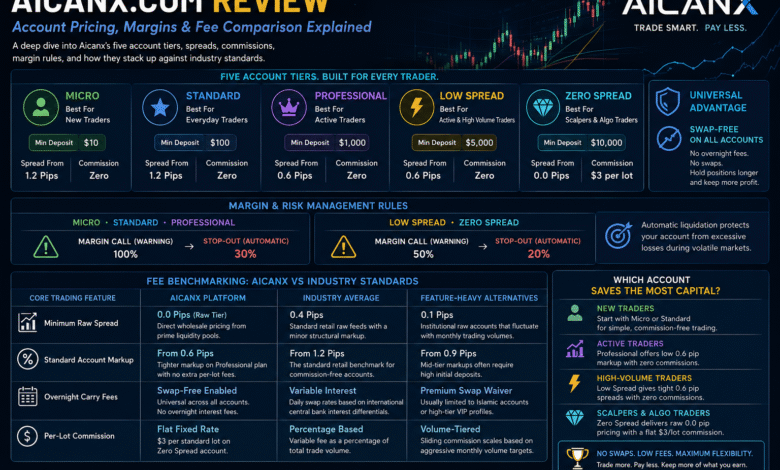
The financial framework used here divides users into clear operational paths designed to fit everyone from casual retail investors to high-frequency, volume-driven algorithmic strategists. Recognizing where these cost lines are drawn helps participants select the most economical layout for their specific setup.
Raw Wholesale Spread Accounts vs. Zero-Commission Models
The entry-level tiers on this network are the Micro and Standard profiles, both of which operate under a completely commission-free fee structure. These setups are tailored for standard retail approaches that prefer a clean pricing model, where recalculating additional per-lot ticket fees for every quick transaction becomes a major hassle.
This Aicanx.com Review notes that base spreads on these starting tiers generally hover around one point two pips on highly liquid currency pairs. Stepping up to the Professional plan keeps that clean, commission-free approach intact but sharpens the underlying pricing engine, bringing the baseline spread down to zero point six pips for users who maintain a minimum deposit value of one thousand dollars.
For short-term day traders and automated trading systems, the real interest lies in the specialized volume setups. This technical Aicanx.com Review focuses on the performance metrics of the Low Spread and Zero Spread options, which link users straight to the deeper layers of the broker’s liquidity pools.
The Low Spread tier offers a highly competitive zero point six pip spread with zero added commissions, serving as a solid middle-ground plan for active accounts. On the other hand, the Zero Spread tier targets true wholesale market pricing, scraping spreads all the way down to a flat zero point zero pips.
To balance this direct market access, the platform applies a transparent, flat commission charge of three dollars per standard lot. This predictable cost setup allows short-term scalpers to calculate their exact breakeven points without dealing with hidden variable fees.
Overnight Fee Relief: Universal Swap-Free Positioning Rules
Keeping trading positions open past the daily New York market close usually subjects a retail account to variable swap fees, which can slowly drain capital from long-term swing strategies. This structural Aicanx.com Review details a unique operational feature built into the broker’s entire account matrix: the inclusion of a universal swap-free framework.
Most brokers lock interest-free setups behind specific regional profiles or specialized religious accounts, but this system drops swaps across all five standard tiers. It gets rid of the typical interest rate gaps that usually trigger daily rollover charges on forex and commodities.
For swing traders holding cross-currency pairs or energy benchmarks like WTI and Brent crude for days or weeks, this completely cuts out overnight financing costs. It makes holding long-term positions much easier to manage without fees chipping away at the balance.
This structural setup allows long-term strategists to preserve their positions through prolonged market trends without worrying about daily funding friction cutting into their final returns.
Margin Enforcement Parameters
Managing risk effectively requires a clear understanding of the automatic safety triggers that go into effect when a trading account faces severe market drawdowns. The underlying system operates distinct risk boundaries to protect network liquidity while giving active positions sufficient room to breathe.
Analyzing the 50% Margin Warning and 20% Automated Stop-Out Levels
The protective protocols on the platform are tied directly to the specific architecture of each account tier. This focused Aicanx.com Review monitors the exact points where automated position liquidations take place.
On the Micro, Standard, and Professional setups, the margin call warning pops up right at one hundred percent. It acts as an early dashboard alert letting you know the account needs cash or some quick position tweaks.
If the chart keeps going the wrong way and capital slides down to thirty percent of the needed margin, the matching engine steps in. It automatically hits a hard stop-out to keep the balance from plunging into a nasty out-of-pocket debt.
For the faster trading options, the risk settings shift to handle much tighter capital use. This technical Aicanx.com Review confirms that the Low Spread and Zero Spread setups drop the margin warning down to fifty percent and set the automatic liquidation trigger at twenty percent.
When an account breaches this twenty percent floor, the core matching engine steps in instantly to close out the most unprofitable active trades first. This precise, systematic liquidation process releases tied-up margin immediately, protecting the remaining account balance from fast-moving price movements during heavy news events.
Fee Benchmarking Architecture
To provide a clear view of how these cost parameters compare to broader market standards, it helps to look at the numbers side by side. This segment of the Aicanx.com Review contrasts the platform’s standard fee layout against common retail broker averages.
Direct Cost Comparison Matrix
The table below provides an expanded breakdown of the operational cost structures, giving market participants a granular look at how specific fee elements behave across different platform models during active sessions.
| Core Trading Feature | Aicanx Platform Layout | Industry Average Framework | Feature-Heavy Alternatives |
| Minimum Raw Spread | 0.0 Pips (Raw Tier)
Direct wholesale pricing pulled from prime liquidity pools without markups on the Zero Spread tier. |
0.4 Pips
Standard retail raw feeds that typically carry a minor structural markup before reaching the client terminal. |
0.1 Pips
Institutional raw accounts that frequently fluctuate based on total monthly trading volumes. |
| Standard Account Markup | From 0.6 Pips
A tighter baseline markup applied automatically to the Professional plan without adding separate per-lot execution fees. |
From 1.2 Pips
The standard retail benchmark for basic commission-free accounts across most mainstream brokerages. |
From 0.9 Pips
Middle-tier account markups that often require a high initial deposit to unlock the pricing tier. |
| Overnight Carry Fees | Swap-Free Enabled
A universal framework applied across all standard configurations, removing daily rollover interest fees on open trades. |
Variable Interest
Daily swap rates calculated continuously using international central bank interbank interest rate differentials. |
Premium Swap Waiver
Overnight fee exemptions that are usually restricted to specific religious accounts or high-tier VIP profiles. |
| Per-Lot Commission | Flat Fixed Rate
A transparent, predictable fee of three dollars per standard lot executed specifically on the Zero Spread account tier. |
Percentage Based
Variable execution fees calculated as a fixed percentage of the total nominal trading volume per transaction. |
Volume-Tiered
Sliding commission scales where the exact cost per side depends heavily on meeting aggressive monthly volume targets. |
This comparative pricing breakdown demonstrates that the underlying fee framework remains highly competitive, especially for active strategies that spend most of their time utilizing the raw zero-pip execution environment.
Conclusion: Which Account Configuration Saves the Most Capital?
Looking closely at how the platform sets up its fees reveals a highly flexible workspace focused on clear pricing. This Aicanx.com Review shows that landing on the most cost-effective account choice comes down to how a person actually places trades.
For retail traders who want straightforward tracking, the Professional plan offers a solid middle ground by matching a low 0.6 pip markup with zero commission fees. Meanwhile, automated bots and heavy scalpers will get more out of the Zero Spread setup, which uses raw 0.0 pip wholesale rates alongside a flat 3-dollar fee to cut out execution friction.
Add in the fact that interest fees on overnight holds are completely waived across all five options, and the entire setup becomes highly efficient. This technical configuration allows active market participants to keep their daily trading expenses down without forcing them to change how they manage their portfolios.