The pace of technological progress has never been faster than it is right now in 2026. From artificial intelligence reshaping how British households manage their daily tasks to wearable health monitors that can predict illness well before any symptoms appear, the boundaries that once separated human experience from digital capability continue to blur at a remarkable pace. Yet this shift goes far beyond gadgets or simple software updates, fundamentally touching how we work, communicate, learn, and even define ourselves as individuals within a rapidly shifting world. This article covers UK tech breakthroughs, personal impacts, and practical advice.
One often overlooked aspect of this rapid digital shift is how individuals and businesses alike need to think carefully about their online identity from the very start. Whether you are launching a creative portfolio, a community project, or a small enterprise, securing the right domain names early on helps establish credibility and ensures your digital presence remains consistent as technology evolves around it. A strong web address acts as an anchor point in an otherwise constantly shifting online world.
How Emerging Technologies Are Redefining Everyday Routines
Smart Home Ecosystems and Predictive Living
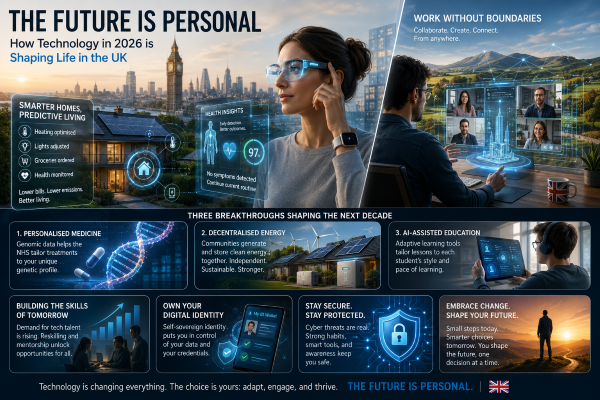
British homes in 2026 look remarkably different from those of just five years ago. Energy management systems now learn household patterns autonomously, adjusting heating schedules, lighting levels, and appliance usage without manual input. The result is lower utility bills and a noticeably reduced carbon footprint. Voice-controlled assistants have moved beyond simple timers and weather queries. They coordinate grocery deliveries based on refrigerator stock levels, remind family members of medication schedules, and even adjust room temperatures when someone shows early signs of a cold. These systems do not simply respond to commands; they anticipate needs. For those interested in the revolution happening in sight enhancement and visual technology, similar predictive principles are driving breakthroughs in augmented reality glasses that adapt lens displays to ambient lighting conditions in real time.
Remote Work and the Dissolution of Geographic Limits
The traditional office model has changed permanently. Spatial computing tools allow British professionals to collaborate in shared virtual environments, sketching on digital whiteboards with colleagues in Tokyo or Toronto as though everyone occupied the same room. Edge computing infrastructure has largely resolved the latency problems that plagued early video conferencing, making the experience genuinely fluid. Employers across various sectors report that productivity metrics have shown notable improvement since the adoption of these new working arrangements, while workers, who now enjoy more control over their daily routines, cite greater satisfaction stemming from the freedom that flexible scheduling provides them. Geographic barriers to rural career opportunities have weakened significantly.
Three Breakthrough Developments Shaping the Next Decade
Among the countless advances that are currently competing for public attention in the scientific and technological fields, three particular developments stand out for their remarkable potential to reshape British society over the coming years:
- Personalised medicine powered by genomic data: The NHS tailors treatments to genetic profiles, improving precision and reducing side effects.
- Decentralised energy grids using community solar and battery storage: UK neighbourhoods pool resources to generate and store renewable electricity locally, reducing dependence on centralised power.
- AI-assisted education platforms adapting to learning styles: Schools in Birmingham, Manchester, and Edinburgh test tools that dynamically tailor content to each student’s preferred learning method.
These developments share a common thread: they move away from one-size-fits-all models and toward solutions shaped around individual circumstances. Research published by the National Institutes of Health examines how technology drives broad cultural transformation, confirming that personalised systems tend to gain faster public adoption because they deliver visible, immediate benefits to each user.
Why Talent Development Matters in a Tech-Driven Economy
None of these advances happen without skilled people behind them. The British workforce faces a growing demand for expertise in machine learning, renewable energy engineering, and data ethics. Universities are restructuring degree programmes to reflect this reality, but formal education alone cannot keep pace. Professional reskilling platforms and mentorship networks have become just as important. For a closer look at how AI and emerging tech are powering future talent pipelines, several recent case studies illustrate how organisations are building internal academies to upskill existing employees rather than relying solely on external recruitment.
The Role of Personal Digital Identity in a Connected World
As more aspects of daily life migrate online, from banking and healthcare to entertainment and government services, the question of how individuals establish and protect their digital identity grows increasingly urgent. British consumers now find themselves managing dozens of separate accounts, which range from banking apps and health portals to streaming services and government platforms, each requiring its own login credentials and personal information. Each account holds sensitive personal data, and managing so many separate platforms — each with its own security protocols and privacy policies — creates significant vulnerabilities that leave consumers exposed to breaches and data misuse. Emerging solutions centre on self-sovereign identity frameworks, where individuals maintain direct control over their own credentials through encrypted digital wallets, rather than placing trust in each separate platform to safeguard their personal information independently. UK early adopters feel greater ownership of their data, and regulators are closely monitoring these pilots as possible national policy models.
Why Securing Your Online Presence Matters More Than Ever
Cyber threats have grown considerably more sophisticated over recent years, evolving in direct parallel with the very security technology that has been designed and deployed to detect and stop them. Phishing attacks now use deepfake audio, and ransomware increasingly targets small businesses. The British government’s National Cyber Security Centre reported a sharp rise in incidents affecting organisations with fewer than fifty employees during the past twelve months. Proactive security measures are now essential. Multi-factor authentication, software updates, encrypted communications, and staff training together constitute the minimum standard for responsible digital behaviour. Data protection culture is changing beyond individual actions. Consumers, who are now more informed and vigilant than ever before, expect a high degree of transparency from the companies they regularly interact with, and businesses that fail to demonstrate strong, clearly communicated security practices risk losing the trust of their customers rapidly and, in many cases, irreversibly.
Embracing Technological Change on Your Own Terms
Adapting to a world that is increasingly shaped by technology does not require that you become an engineer or that you memorise every single new product release that hits the market. It starts with genuine curiosity and a sincere willingness to experiment, which together form the foundation that allows anyone to gradually become more comfortable with new tools and technologies. Give a new productivity tool a test run for about a week. Find out how a wearable fitness tracker can change your exercise habits. Take the time to investigate whether a smart thermostat genuinely reduces your energy bills by comparing your monthly costs before and after installing the device in your home. Small, intentional steps build confidence and help you tell truly useful tools from temporary fads. The important thing is to stay engaged with technology rather than feeling overwhelmed by it. Technology will keep moving forward regardless of whether we choose to pay attention. Those who choose to engage with technology on their own terms — actively asking questions, testing boundaries, and making well-informed choices — will find themselves far better positioned to benefit from the many opportunities that lie ahead. The future is not something that simply happens to you without your involvement. It is something that you actively shape through your own deliberate choices, where each single decision you make, no matter how small or seemingly insignificant it may appear at the time, contributes meaningfully to the broader direction of your life in a technology-rich world.
Frequently Asked Questions
What are the most common mistakes people make when implementing new technology in their daily routines?
The biggest pitfall is adopting too many new technologies simultaneously, leading to overwhelm and abandonment of potentially useful tools. Many people also skip proper setup procedures, missing key security configurations and customization options. Start with one new technology at a time, invest time in learning its full capabilities, and establish consistent usage habits before adding additional digital tools to your routine.
Where can I secure a professional domain name to establish my digital identity for future tech ventures?
Building a strong digital foundation starts with selecting the right web address that can grow with your technological initiatives. IONOS offers comprehensive domain names registration services, helping you establish credibility and maintain consistency as your digital presence evolves alongside emerging technologies. Consider securing multiple domain extensions to protect your brand identity across different platforms and services.
How much should I budget annually for keeping up with essential tech upgrades?
Technology budgeting varies widely based on your professional needs and personal preferences, but financial experts suggest allocating 3-5% of your annual income for tech maintenance and upgrades. This covers device replacements, software subscriptions, security tools, and emergency repairs. Prioritize spending on devices you use daily for work, then allocate remaining budget to entertainment and convenience technologies that enhance your lifestyle.
Which technology skills are most critical to learn for career advancement in the next five years?
Digital literacy now extends beyond basic computer skills to include data analysis, cybersecurity awareness, and AI collaboration techniques. Focus on learning how to work alongside automated systems rather than competing with them. Cloud computing fundamentals, basic coding concepts, and digital project management tools have become essential across most industries, even in traditionally non-technical roles.
What are the biggest privacy risks when adopting smart home technology?
Data collection from connected devices poses significant privacy challenges, as manufacturers often gather detailed behavioral patterns, location data, and personal preferences. Many users unknowingly grant broad permissions during setup, allowing companies to share information with third parties. Review privacy settings regularly, use separate network segments for smart devices, and consider which data points you’re comfortable sharing before connecting new gadgets to your home network.