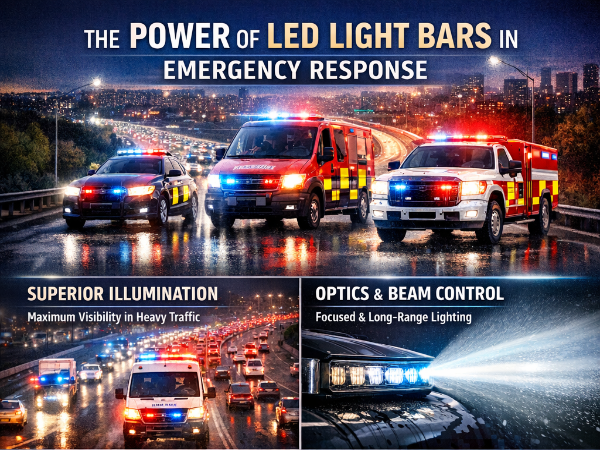
Speed, coordination, and decisive action are essential for any emergency response team operation. However, the most critical factor is the illumination of the vehicles providing lighting for emergency response. With LED light bars, emergency response vehicles are now delivering superior performance compared to the older-style light bars. The overall performance of a light bar is determined by the design of the product. This means how well it controls brightness and how well it projects light in all directions.
Why Illumination Matters More Than Ever
There is an enormous increase in traffic on today’s roads and highways. The demand for visibility is much higher than it has ever been. This increase in traffic leads to a greater amount of visual distractions, such as other vehicles, digital display screens/dashboard, and reflective surfaces. This may cause slow reactions and mistaken behaviours by the drivers. Following this line of reasoning, providing maximum visibility for road users should be the priority when responding to an emergency. Therefore, instead of depending on the road lights, emergency vehicles need to install compatible LED lights for added visibility.
What Actually Makes LED Light Bars So Effective
LED systems convert electrical energy into light, making them extremely efficient. Unlike incandescent and halogen bulbs, LEDs provide instantaneous illumination, producing response signals that appear sharp and quick. LED light bars produce minimal heat. Which increases its longevity and performance consistency. More critically, even if the voltage drops, LEDs will retain their brightness. In response to vehicle operations where reliability is important, the consistency of an LED is a significant advantage.
The Role of Optics and Beam Control
Brightness alone will not ensure proper illumination for emergencies. Optics affect the way light travels, is distributed, and reflects towards the driver’s eyes. Lenses and reflectors are specifically designed for precision focusing on the area of need. Therefore, the reduction of glare and long-distance visibility is achieved through the optical beam patterning. Well-designed optical systems minimise wasted light that may create potential distractions to other drivers in the area. A properly designed optical beam pattern allows for greater consistency of warning signals.
Diverse Effects of Colour, Contrast, & Flash Patterns
Colours, contrast, and flashing patterns affect your responses differently. Certain colours stimulate quicker identification and separation from surrounding lights. In addition to contrast, alternating flashing may contribute to preventing visual fatigue and increasing attention span. When lighting adheres to the limits of human perception, it prevents visual fatigue and aids in long term attention of the driver. Effective LED light bars thus operate on this colour and contrast theory to create a safer driving environment.
Performance in Real-World Conditions
Response vehicles are exposed to rain, fog, dust, and temperatures far exceeding the conditions during a lab test. Therefore, the lighting must remain uninterruptedly “lit” even under adverse conditions. The qualities that contribute to a well-performing lighting system include the ability to resist water ingress, vibration, and corrosion from long use. Additionally, a good-quality lighting system will produce consistent illumination, thereby ensuring the clarity of the lighting regardless of longer deployments. The true performance of the LED lights will be tested during adverse weather and road conditions.
Interpreting technical specifications
Technical specifications are often numbers stated without sufficient context, particularly with regard to their use when making a purchase decision. However, understanding a technical specification makes all the difference in improving your buying experience. For example, lumens represent the quantity of light produced by a product. On the other hand, optics will determine the quality of the produced light. Using voltage compatibility helps guarantee that the equipment is used successfully across multiple vehicle systems. Ratings of ingress protection indicate how durable the product will be in the face of exposure to the elements. Flash patterns and synchronisation options will determine the clarity of communication. There should be a strong correlation between technical specifications and how the equipment will function together as a system.
Working with Specialists Who Understand Response Lighting
Working with the right partner for purchasing properly responsive vehicle lighting is crucial for your safety. Response Vehicle Lighting distinguishes itself among lighting manufacturers by providing a range of products designed specifically for the unique requirements of emergency and other specialist vehicles. Their lighting products are superior in terms of durability, precision of optics, and compliance with governmental regulations. In addition to producing vehicle-specific products, they also offer a broad range of compact and portable lighting products. With advanced synchronisation capability, you can expect optimum performance in your preferred vehicle. When the reliability of response vehicle lighting is at stake, the experience you get from an industry specialist matters a lot. Therefore, to ensure safety during emergency operations, it is important to invest in quality LED light bars from a reputable manufacturer. This will gift you reliability along with maximum performance.