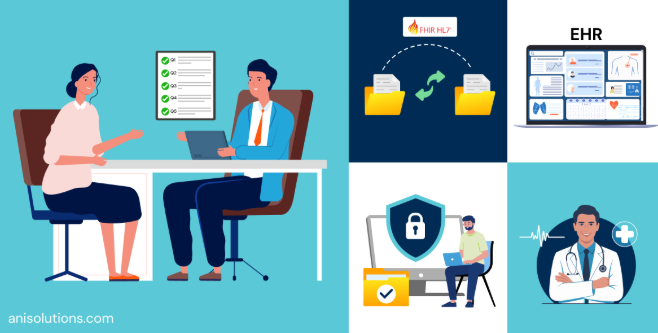
When you hire EHR developer, the process and criteria are completely different from how you do it for general software developers. But most of the time, the EHR development interview goes in the same way, asking the same questions that are asked to generic developers.
However, this can become the biggest mistake for healthcare organizations in the long term. Because unlike any other software, EHR sits at the center of the entire hospital, and it is built on regulatory compliance. Most importantly, it stores all the sensitive patient information, and that’s why every design decision affects how clinicians document, how data flows across the system, and how secure the system is.
Yet, many hiring teams use the same framework and questions for technical skills and don’t ask questions that can evaluate their healthcare domain expertise. But, it’s important to ask the right EHR developer interview questions for smooth and efficient custom EHR development.
In this guide, we have explored some must-ask questions for hiring EHR developers who are skilled in developing EHR, which is scalable, secure, and interoperable, not just functional software.
Let’s dive in!
Questions to Assess Technical & Integration Skills
In healthcare software development, technical skills needed go beyond just how fast they write code or deploy features. The EHR works in connected environments, so the EHR developer needs to have the ability to seamlessly integrate labs, pharmacies, and billing systems for seamless data exchange. You need to evaluate whether a developer can manage this level of complexity reliably at scale.
The first question you must ask during the interview is about their experience with healthcare data exchange standards. Rather than checking the familiarity with the standards, understand how they have implemented HL7 and FHIR in other projects, how they handled data validation, and solved system inconsistencies in real production environments.
After this, evaluate their ability to integrate external systems with EHR without disrupting the existing workflows. You need to confirm whether they build API-first architecture or just connect workflows on the surface, limiting the scalability and flexibility of the EHR system. Only select the developers who think APIs and workflows need to be built together rather than separately.
One of the most important parts of the custom EHR development is the legacy data migration. Ask the developers what approach they take for migrating the data. An experienced developer can discuss validation strategies and know that it needs to be handled in phases rather than transferring entire datasets.
Finally, evaluate their understanding of the performance and scalability of EHR. The EHR needs to function smoothly even during the peak hours of the clinic without slowing down or lagging. Before deciding, look at how the developers design reliable and responsive systems and how they respond as data volume grows.
Questions About Security, Privacy, & Compliance
The EHR software contains sensitive information about thousands of patients, and the software must be secure enough to keep it protected and private. For this, the EHR developer needs to understand the regulations and compliance in the healthcare landscape.
So, start by asking about the developer’s experience in developing a HIPAA-compliant EHR from th day one. Verify that they understand the concept of end-to-end encryption, access control, and audit logging for passing the compliance test.
Along with this, evaluate whether they know how the access control works with passwords, biometrics, and other methods, alongside which roles need what user permissions. As in healthcare, not every role needs to have full access to patient data, and the access must be limited to a certain extent to keep data private. However, make sure that they also know about the emergency access and how to provide it without compromising security.
Moreover, the audit logging and monitoring should also be addressed in detail. Ask how system activities are tracked, how logs are secured, and how unusual behavior is detected and investigated. An experienced developer understands that audit logs are not just for passing compliance but to monitor security and incident response.
Finally, assess their awareness of evolving healthcare standards and regulations as they change over time. That’s why the EHR also needs to be updated with the change. If the developer is keeping up with changing regulatory requirements, then he understands compliance and knows how to build a compliant EHR.
Questions That Reveal Clinical Workflow Understanding
One of the biggest differentiators between an EHR developer who builds usable systems is the understanding of clinical workflows. And technical skills alone are not enough to build a software how care is actually delivered.
Start by asking how clinicians are involved in the design and validation process. Strong candidates will describe direct collaboration with physicians, nurses, or care teams through workflow reviews, feedback cycles, and real-world testing. Developers who rely solely on assumptions or second-hand requirements usually miss critical details that affect usability and adoption.
Ask candidates how they have reduced manual data entry, streamlined clinical notes, or minimized unnecessary clicks. Experienced EHR developers understand that excessive documentation contributes to burnout and actively design interfaces that support efficient charting without sacrificing data integrity.
With the reduction of the documentation burden, the developers must also address alert fatigue. Developers with healthcare experience recognize that poorly designed alerts can be ignored or overridden, creating safety risks. Look for answers that demonstrate thoughtful alert logic, prioritization, and clinician-driven tuning rather than blanket notifications.
Finally, assess their ability to build specialty-specific workflows. Generic templates rarely meet the needs of different clinical specialties. Developers who can translate nuanced clinical requirements into flexible, role-aware software features are more likely to deliver EHR systems that clinicians trust and actually want to use.
Questions About Future-Readiness & AI Awareness
Future-ready EHR systems are not designed based on EHR features, but on how well they adapt to change. As regulations evolve, data volumes grow, and automation becomes more common, organizations need EHR developers who design for sustainability, not short-term delivery.
The first thing you must check is a candidate’s experience with automation or AI-assisted features. Rather than focusing on buzzwords, ask how they have implemented automation responsibly, such as supporting clinical documentation, streamlining administrative workflows, or improving data quality. Strong candidates understand that in healthcare, AI must enhance clinical judgement, not replace it.
System adaptability is equally important; ask how developers architect the EHR platform to accommodate future regulatory changes without requiring major rework. Developers with healthcare maturity think in modular components, configurable workflows, and policy-driven logic that can evolve as compliance and reporting requirements change.
Scalability should also be discussed from a long-term perspective. Future-ready developers plan for increasing patient volumes, new care models, and additional integrations without compromising performance or usability. Their answers should reflect experience building systems that grow incrementally rather than relying on disruptive rebuilds.
Also, assess how they balance innovation with safety. In EHR development, progress must be deliberate, and developers who can articulate clear governance, validation, and rollback strategies for new features demonstrate an understanding of healthcare’s risk-sensitive environment.
Conclusion
Hiring the right EHR developer is usually a risk-management decision. The wrong choice can lead to workflow disruptions, compliance gaps, and costly rework that compounds over time. By asking structured, healthcare-specific questions in the interview, organizations can evaluate more than technical ability; they can assess clinical understanding, security awareness, and long-term system thinking.
Competence, compliance, and workflow insight must be weighed equally to build EHR systems that are reliable, scalable, and trusted by clinicians. A disciplined evaluation process not only reduces hiring risk but also ensures the EHR delivers sustained value as healthcare technology and regulations continue to evolve.
So, if you are looking for EHR developers who can develop a scalable and compliant EHR, click here to book a free call with our developers.
Frequently Asked Questions
- What interview questions should I ask before I hire an EHR developer?
Ask questions that assess healthcare data integration experience, compliance-by-design thinking, clinical workflow understanding, and scalability planning. Focus on real projects, not theoretical knowledge, to uncover whether the developer can handle EHR complexity.
- How do I evaluate healthcare domain expertise in EHR developers?
Evaluate whether candidates understand clinical workflows, documentation burden, interoperability challenges, and regulatory constraints. Strong developers can explain how clinical needs shaped their design decisions and how they validated solutions with healthcare stakeholders.
- Why is compliance experience critical when hiring EHR developers?
EHR systems handle sensitive patient data and are subject to strict regulations. Developers with compliance experience design audit-ready systems, enforce proper access controls, and reduce the risk of data breaches, penalties, and costly post-launch remediation.
- What questions reveal EHR interoperability skills?
Ask candidates to describe real integrations with labs, billing systems, or third-party tools. Look for explanations of data mapping, validation, error handling, and workflow impact—strong indicators of hands-on interoperability experience.
- How can interview questions prevent EHR project failures?
Well-structured interview questions expose gaps in healthcare knowledge, compliance awareness, and workflow understanding early. This helps organizations avoid hiring developers who build technically functional systems that fail clinically, operationally, or at scale.